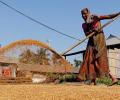
Chandigarh is set to launch the Central Bank Digital Currency (CBDC), or digital rupee, for Direct Benefit Transfer (DBT) under the Pradhan Mantri Garib Kalyan Anna Yojana (PMGKAY) on August 14. This initiative makes Chandigarh the first Union Territory to fully roll out CBDC-based DBT for food subsidy, enhancing transparency and efficiency in welfare delivery. The digital rupee, issued by the RBI, will be purpose-bound for purchasing foodgrains from authorised merchants.

Karnataka authorities conducted a three-day statewide crackdown on illegal diversion of subsidised Public Distribution System (PDS) foodgrain, seizing 5.65 lakh kg of rice and 24 transport vehicles worth a total of Rs 4.76 crore. Six criminal cases have been registered against nine individuals, and two officials have been suspended for dereliction of duty.

'The priority of the government should be to use agricultural production for human beings first, and only after that for biofuel and such things.'
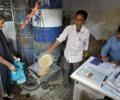
The Delhi government has cancelled over 45,000 ration cards and is considering using artificial intelligence to identify ineligible beneficiaries in its public distribution system.

If the new MDR regime is rolled out from the middle of this month, as scheduled, it should count as one of the boldest political actions by the Modi government on an economic-policy issue, and a signal that it is less worried about erosion of political capital it draws from one of its key constituencies, notes A K Bhattacharya.

The government has extended the Pradhan Mantri Garib Kalyan Anna Yojana (PMGKAY) scheme to provide 5 kilogrammes of free foodgrains per month to around 80 crore poor people for another five years.

The government has extended the PMGKAY scheme to provide 5 kg free foodgrains per month to around 80 crore poor people for another five years. A decision in this regard was taken in the meeting of the Cabinet, chaired by Prime Minister Narendra Modi, on Tuesday. Giving details on Wednesday, Information and Broadcasting Minister Anurag Thakur said the Pradhan Mantri Garib Kalyan Anna Yojana (PMGKAY) has been extended for another five years from January 1, 2024.

Shiromani Akali Dal (SAD) president Sukhbir Singh Badal has criticised the Aam Aadmi Party (AAP) government in Punjab, alleging a decline in law and order and accusing them of using financial schemes to sway voters ahead of elections.

In the first sign of dissent within the ruling UPA government, Agriculture & Food Minister Sharad Pawar on Wednesday indicated that covering two-thirds of the population under the proposed Food Security Bill was not feasible.
The IEO, which has been entrusted to assess public programmes, has found that 57 per cent of the subsidised foodgrains distributed in Delhi, do not reach the target group with close to 36 per cent siphoned off the supply chain.
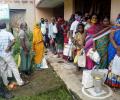
A bench of Justices MR Shah and Hima Kohli directed the Centre to submit a fresh chart with the number of migrant and unorganised sector workers registered on eShram portal.
The recently promulgated National Food Security Ordinance might breach the global trading rules on agriculture under the World Trade Organization if there is diversion of the subsidised foodgrain for export.
Stating that the food subsidy bill is becoming "unmanageably large", the Economic Survey 2021 on Friday suggested the government to increase the selling price of foodgrains provided through ration shops to over 80 crore beneficiaries. Foodgrains via ration shops are supplied at highly subsidised rates of Rs 3 per kg for rice, Rs 2 per kg for wheat and Rs 1 per kg for coarse grains through Public Distribution System (PDS) as per the National Food Security Act (NFSA). "While it is difficult to reduce the economic cost of food management in view of rising commitment towards food security, there is a need to consider the revision of central issue price (CIP) to reduce the bulging food subsidy bill," the survey said.
Even as frenzied debate continues over the Food Security Bill ordinance in Parliament, here are 7 facts that you must know about the legislation.
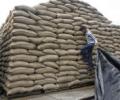
Government's cheap food distribution covers 68 per cent of the population.
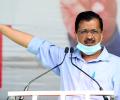
The central government on Friday stopped the doorstep delivery of ration scheme MMGGRY (Mukhya Mantri Ghar Ghar Ration Yojana) of the Delhi government, scheduled to be launched on March 25.

The Prime Minister's expert committee on National Food Security Bill on Thursday recommended that the assured delivery of wheat at Rs 2/kg and rice at Rs 3/kg could be given only to poor and expressed difficulty in accommodating general category in view of projected food availability.
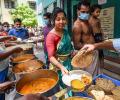
A decision in this regard was taken in the Cabinet meeting chaired by Prime Minister Narendra Modi.

The Union Cabinet on Wednesday approved a proposal to extend distribution of 5 kg foodgrains per month for free under the Pradhan Mantri Garib Anna Yojana (PMGKAY) to over 80 crore ration card holders for four months till March 2022, a decision that will cost an additional Rs 53,344 crore to the exchequer.
Earlier this week, the Empowered Group of Ministers approved the draft of the Food Security Bill, which will entitle 75 per cent of rural households and 50 per cent of urban households to subsidised foodgrain.

In the proposed law, beneficiaries have been divided into two categories-- priority households and the general households.
Launching a scathing attack on the government for 'loot' of public money through the 2G spectrum allocation and other scams, Left parties on Wednesday took Prime Minister Manmohan Singh to task for equating the loss with subsidising foodgrains to the poor.

The government on Wednesday sought public comments on the draft National Food Security Bill, which seeks to provide a legal entitlement to subsidised foodgrains to 75 per cent of the country's rural population and 50 per cent of urban India.

Expanding its commitment to provide subsidised foodgrain to the poor, the Manmohan Singh government is looking at a host of social sector initiatives along with its soon-to-be-unveiled Food Security Bill.

The Food Security Act as proposed by the UPA government assures rice/wheat at Rs 3 a kg to BPL families as a matter of legal right.
The study of the Targeted Public Distribution System, which covered 18 states, held that though the offtake per household has shown improvement yet only about 57 per cent of the below the poverty line households are covered. The information was given by minister of state for finance Pawan Kumar Bansal in the Rajya Sabha on Tuesday. Based on evaluation studies and feedback received from states, a nine point action plan has been jointly formulated.

'What the US appears to be doing is to force India to be "the buyer of last resort", on whom their products can be dumped, 1.4 billion people have to eat something, so why not eat American corn?' 'What is exercising the Trump lot is the fact that most of the farms are in solidly Republican Midwestern states: Illinois, Indiana, Kansas, Michigan, Minnesota, Missouri, Nebraska, North Dakota, Ohio, South Dakota, Wisconsin,' points out Rajeev Srinivasan.
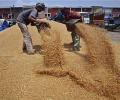
Wants to gear up for implementation of the proposed Food Security Act.
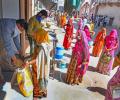
The government's food subsidy in the ongoing fiscal year is expected to be a little less than Rs 4 trillion.

The Food and Security Bill will be implemented after few months.

The government's fiscal deficit may exceed the target of 4.8 per cent of GDP by 0.50 percentage points in this financial year, and money-guzzling measures like decision to push the Food Security Bill are only expected to complicate the matter.

Former UN Secretary General Kofi Annan has warned India against too many populist subsidies
The government is likely to firm up next week a view on how to go about the food security bill. Indications to this effect were available on Wednesday with the government sources saying a decision will be taken only after Agriculture Minister Sharad Pawar's return from Rome where he has gone to attend Food and Agriculture Organisation conference.

At the height of the agitation against Tata Motors and after, the decibel level at Singur has always been high. The coronavirus scare, however, appears to have tempered it. The lockdown has hit Singur's inhabitants hard in more ways than one, reports Ishita Ayan Dutt.

The Supreme Court of India expressed concerns about the long-term sustainability of providing free rations to migrant workers, emphasizing the need for job creation and capacity building instead. The court's remarks came during a hearing on the ongoing issue of providing relief to migrant workers, a matter that gained prominence during the COVID-19 pandemic. The court questioned the government's reliance on freebies and stressed the importance of creating opportunities for migrant workers to become self-sufficient. The debate highlighted the challenges of balancing immediate relief with long-term economic solutions for vulnerable populations.

The Congress will only be able to gain from the bill if its benefits percolate down to the people within the next eight months, says Anita Katyal

WTO's new director has said that the issue needs to be addressed in a positive manner.

The day-long conference will be chaired by Finance Minister Arun Jaitely and presided over by both Food Minister Ram Vilas Paswan and Agriculture Minister Radha Mohan Singh.
